

Stochastic Caving Workflow
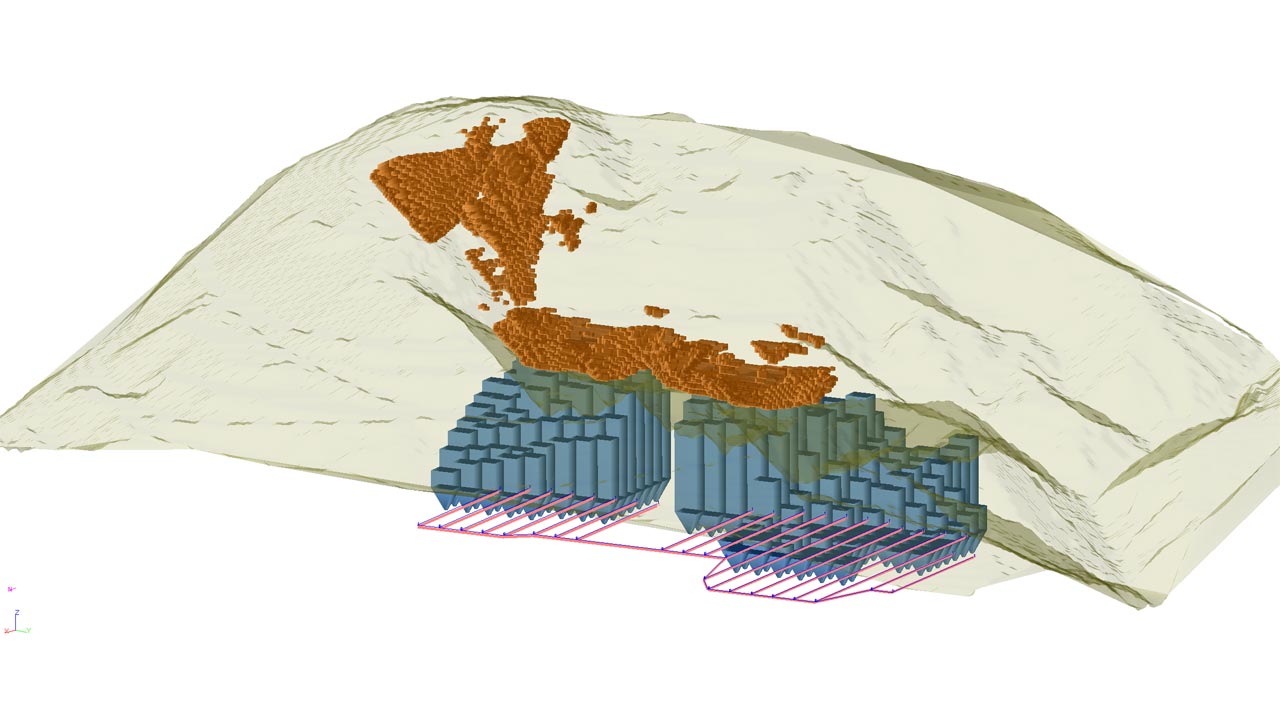
The GeoMine Stochastic Block Caving Workflow runs the Cavemizer footprint optimizer across a set of block model realizations, builds a single consensus cave design, and schedules that design against every realization with a full column-depletion cave scheduler.
Block caving is the mining method least tolerant of a wrong footprint decision: once the undercut is developed, the footprint and elevation are fixed for the life of the cave. The Stochastic Block Caving Workflow lets each realization find its own optimal undercut elevation and footprint, accumulates block votes, and thresholds them into one consensus cave design. The consensus design is then scheduled once per realization with Vertical Pre-Mixing or Laubscher-style mixing, draw rate ramp-up and undercut sequencing, producing a P10/P50/P90/Mean NPV distribution.
The workflow is driven from a three-tab dialog (General, Caving, Scheduling) and is also fully scriptable through the GeoMine automation interface.
The Stochastic Block Caving Workflow depends on the following GeoMine module: Cavemizer + Caving Simulator & Scheduler.
Key Benefits:
- Robust Footprint and Undercut Elevation: The consensus cave design contains only the draw columns that a user-chosen fraction of realizations agree are economic, so the irreversible undercut decision is made on the whole realization set.
- NPV Distribution with Realistic Draw: Scheduling includes vertical mixing, dilution entry, draw rate ramp-up and undercut advance limits, so the P10/P50/P90/Mean NPV reflects how the cave will actually be drawn.
- Visible Uncertainty: Per-block cave probability is written to the block model, showing where the footprint is firmly economic and where it depends on the estimate.
-
Productivity: N footprint optimizations and N schedules are run from one dialog in a single unattended pass.
- Consistency: Uses the same Cavemizer and Caving Simulation & Scheduler engines, and Formula Editor economics as your deterministic cave design and simulation.
Feature List:
Multi-Realization Footprint Optimization with Undercut Elevation Search
For each realization and each candidate cell layout, searches the user-specified elevation range for the optimal undercut Z and generates the corresponding cave design, honouring minimum footprint widths in the E/W, N/S and elevation directions.
Consensus Cave Design
A consensus formula is built from the probability threshold, and the footprint optimizer is run once more to produce the single consensus cave design with cave rings.
Extraction Level Layout Rules
Consensus footprints can be laid out with El Teniente or Herringbone extraction level geometry, with draw point spacing, cross-cut dimensions and front drive offset under user control.
Column Depletion Cave Scheduler
Schedules the consensus design once per realization with a column-depletion model: primary and secondary draw rates (tonnes per square metre per day) with a linear ramp between them, an undercut advance rate limit in square metres per year, and user-defined period lengths.
Vertical Pre-Mixing HOD or Laubscher Mixing
Material mixing based on Vertical Pre-Mixing Minable Height Of Draw (MHOD) or Best HOD (BHOD), or Laubsher-style Mixing, so scheduled grade reflects dilution entry rather than in-situ grade.
Undercut Sequencing with Priority Bands
Undercut order is driven by priority bands assigned per draw point or per closed polyline region, with automatic geometric ordering within each band.
Stockpiling and Blending
Optional stockpiles with rehandle charge and ore blending with user-defined attribute blending rules.
P10/P50/P90/Mean NPV and HTML Risk Report
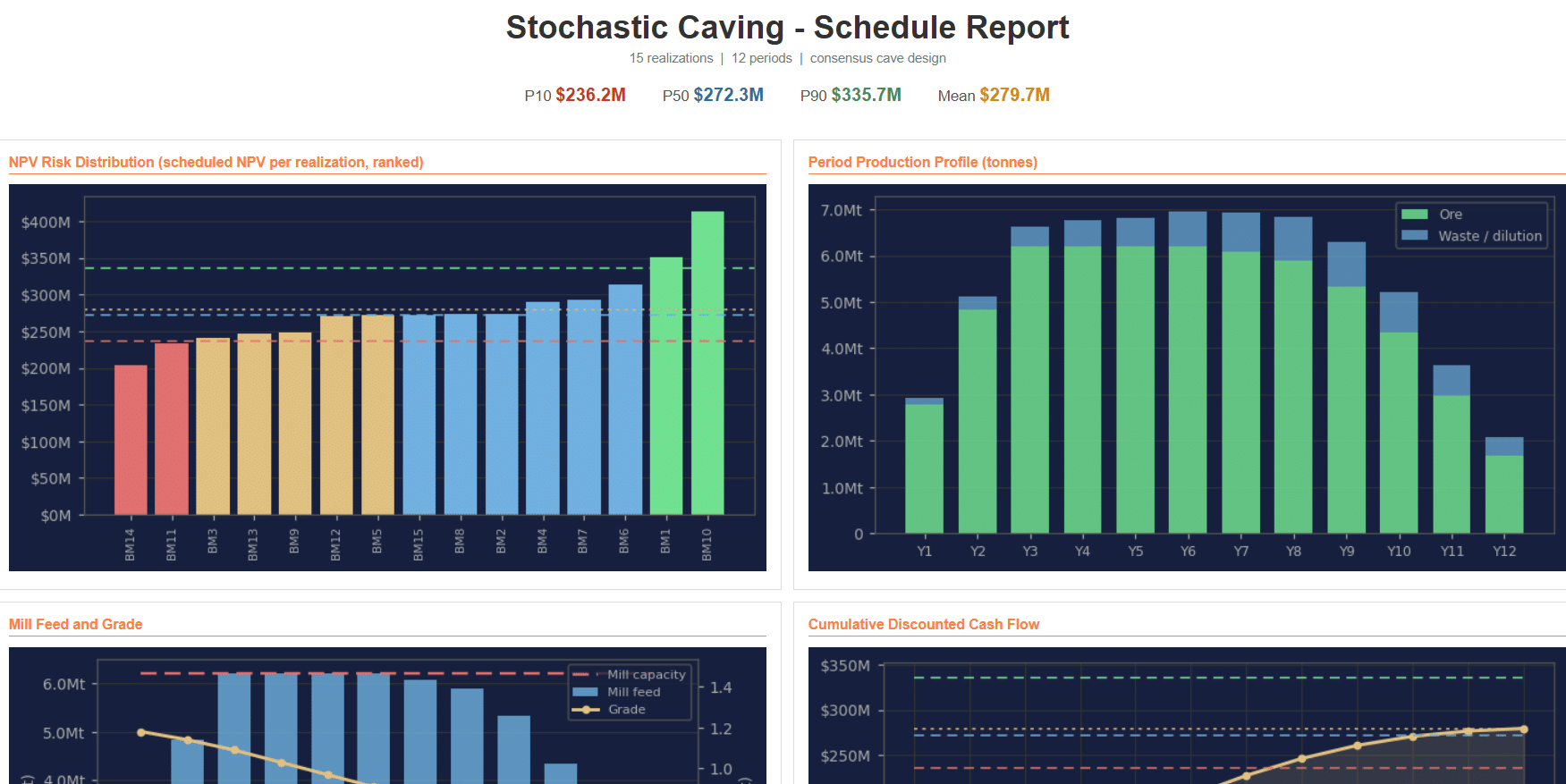
Produces per-realization NPV and a self-contained HTML report with four charts: NPV risk distribution with P10/P50/P90/Mean reference lines, period production profile (ore and waste), mill feed and grade, and cumulative discounted cash flow. A companion CSV of the chart data is written alongside.
Three-Tab Workflow Dialog
General (input realizations, reference model, output folder), Caving (layouts and elevation ranges, minimum footprint widths, cave geometry, consensus threshold) and Scheduling (periods, capacities, discount rate, run-scheduling toggle). Settings are saved between sessions.
Automation Interface
Footprint finder, vote accumulator, consensus builder and caving scheduler are exposed as COM objects to the GeoMine C# scripting environment for batch and sensitivity runs.
System Requirements:
CPU: Quad Core
RAM: 16gb
HARD DRIVE: 500gb SSD
VIDEO CARD: 1gb VRAM
CPU: 3rd Gen Ryzen 5/7 or Intel i7
RAM: 32gb
HARD DRIVE: 1tb SSD
VIDEO CARD: 2gb VRAM