

Cave Optimization, Design, Simulation & Scheduling
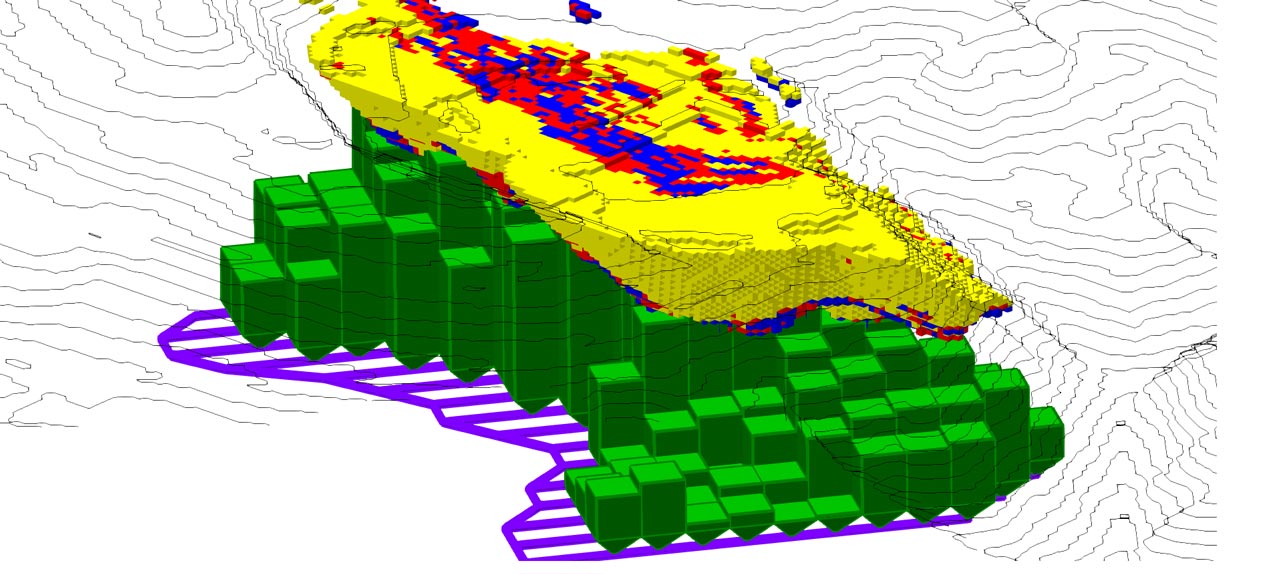
GeoMine Cavemizer (Cavemizer) is a cave optimization, parametric design, simulation and scheduling tool for block caving operations. Cavemizer includes an automatic footprint finder, a parametric cave designer, a void propagation and filling simulator and a life of mine scheduler. Given a grade model and a set of economic parameters, Cavemizer automatically determines the best footprint and interactively generates the corresponding cave design, it then simulate the material flow of block caving operations and generate optimized production schedules.
Cavemizer Key Benefits
- Automatic multi-footprint finding, Laubsher or Pre-Vertical mixing and scheduling allow the mine planner to quickly conduct "what-if" scenario analysis
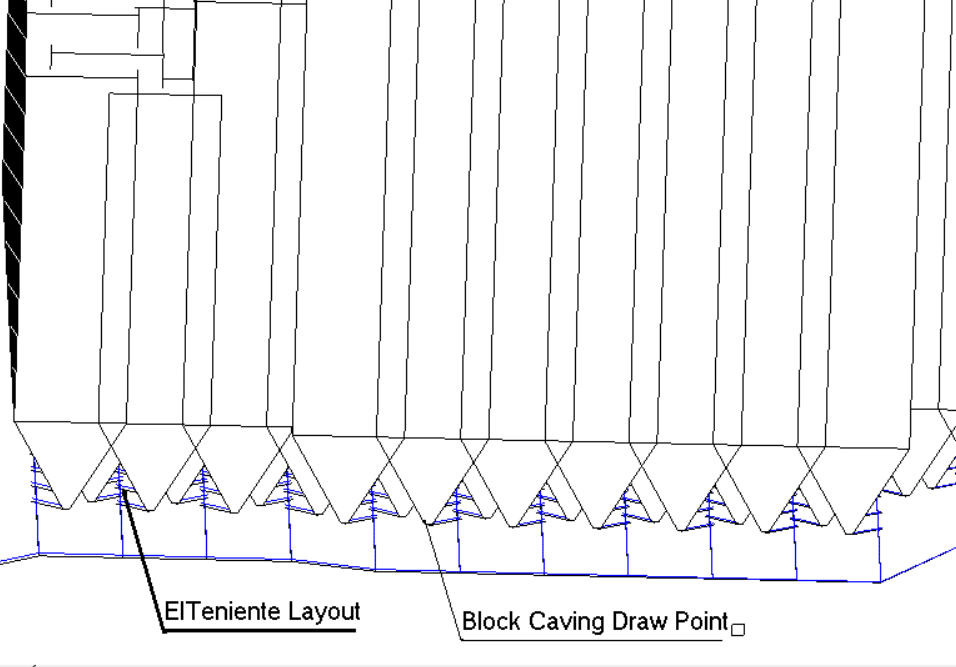
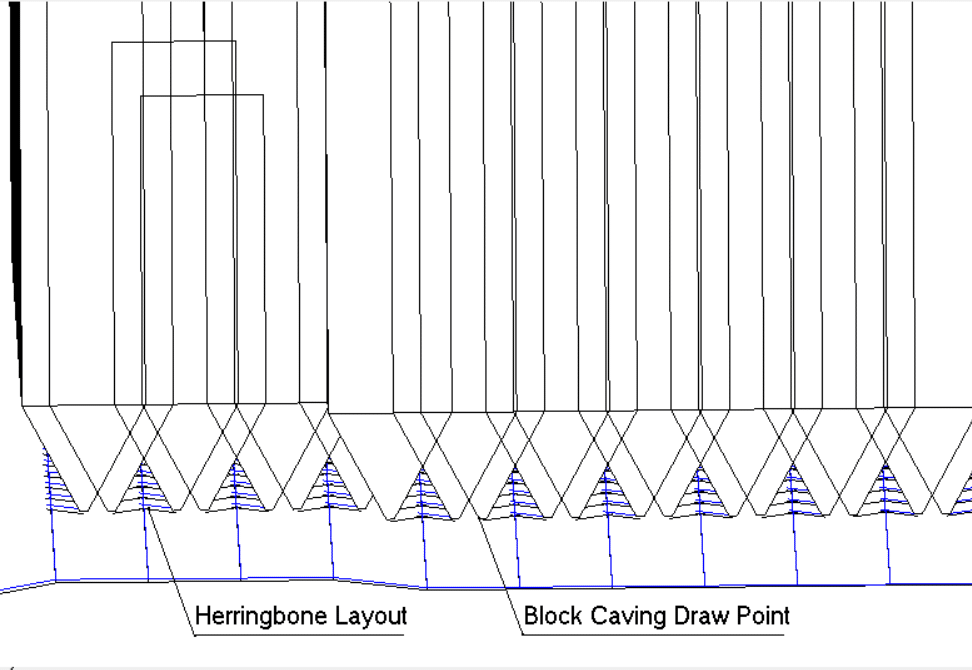
- Designs that reflect real mine layouts. Drawpoints come from El Teniente or Herringbone geometry rather than an arbitrary grid, so a cave design looks like something that could be built — with production drifts, drawbells and drawpoint drifts in the right relationship.
- Spacing becomes a variable you can study. Drift spacing and drawpoint spacing are design inputs, so their effect on recovery, dilution and NPV can be tested rather than assumed.
- Drawpoint interaction is visible while designing. A live readout shows whether drawzones are interacting or drawing in isolation, so a spacing that would leave rock between drawzones is caught at design time.
- Schedules you can inspect drawpoint by drawpoint. Height of draw and tonnage per period per drawpoint, exportable and directly viewable as animated 3D surfaces — the draw front across the footprint, and uneven draw between neighbours.
Cavemizer Feature List
Multi-Footprint Finder
Automatically determines the best footprints for a single block model. Multi-footprints are supported.
Parametric Cave Geometry
Extraction level layout rules. El Teniente and Herringbone, generated from drift geometry. Parameterised by drift spacing, drawbell station pitch and major apex width, with drawpoint drift length derived so the apex is always valid. Production drifts are the cross-cuts, so drift direction follows the front drive automatically.
Automatic development generation. Production drifts, drawbell stations and angled drawpoint drifts created as level development and trimmed to the footprint. Cross-cut extents derive from the drawpoints that survived the mesh tests, so drifts and rings are the same set by construction.
Drawzone sizing. Cone footprint entered directly or matched to the drawpoint’s share of the extraction level, with a live readout of drawzone spacing against diameter flagging interactive versus isolated draw.
Parametric cave designer. Ring geometry, cone slope and bottom profile, cross-cut profiles, front drive placement, single-level block cave and multi-level SLC paths.
Caving Simulation & Scheduling
Column depletion model: Each cave ring is one inverted cone forming a single draw column ordered bottom-up.
Laubscher or Pre-Vertical mixing — height of interaction zone, fines migration, draw control factor.
Undercut sequencing with lobe detection and priority bands.
Design-driven scheduler inputs. Drawpoint area from the layout tile, drawzone spacing measured across generated positions.
Nearest-drawpoint block ownership. Overlapping drawzones partitioned geometrically rather than by processing order.
Multi-footprint and per-stockpile handling, with per-period stockpile flows and grades.
Results and Reporting
Per-draw-point schedule capture — height of draw and tonnage per drawpoint per period, height derived from the draw front rather than from tonnage.
CSV export from the Presentation tree: HOD grid, tonnage grid and a production summary, in the wide layout gridded-surface tools expect.
Per-period analysis — tonnage and grade streams, dilution reporting, NPV and discounted cash flow, block-model period colour coding, HTML report generation.
Includes GeoMine uCAD and Foundation modules
Cavemizer requires GeoMine uCAD and Foundation modules. Please click this link for GeoMine uCAD Feature List.
System Requirements:
CPU: Quad Core
RAM: 8gb
HARD DRIVE: 500gb SSD
VIDEO CARD: 1gb VRAM
CPU: 3rd Gen Ryzen 5/7 or Intel i7
RAM: 16gb
HARD DRIVE: 1tb SSD
VIDEO CARD: 2gb VRAM