

Stochastic Open-pit Workflow
The GeoMine Stochastic Open-Pit Workflow runs FlowPit across a set of block model realizations and combines the results into a single consensus pit design whose reserve and NPV risk are quantified rather than assumed.
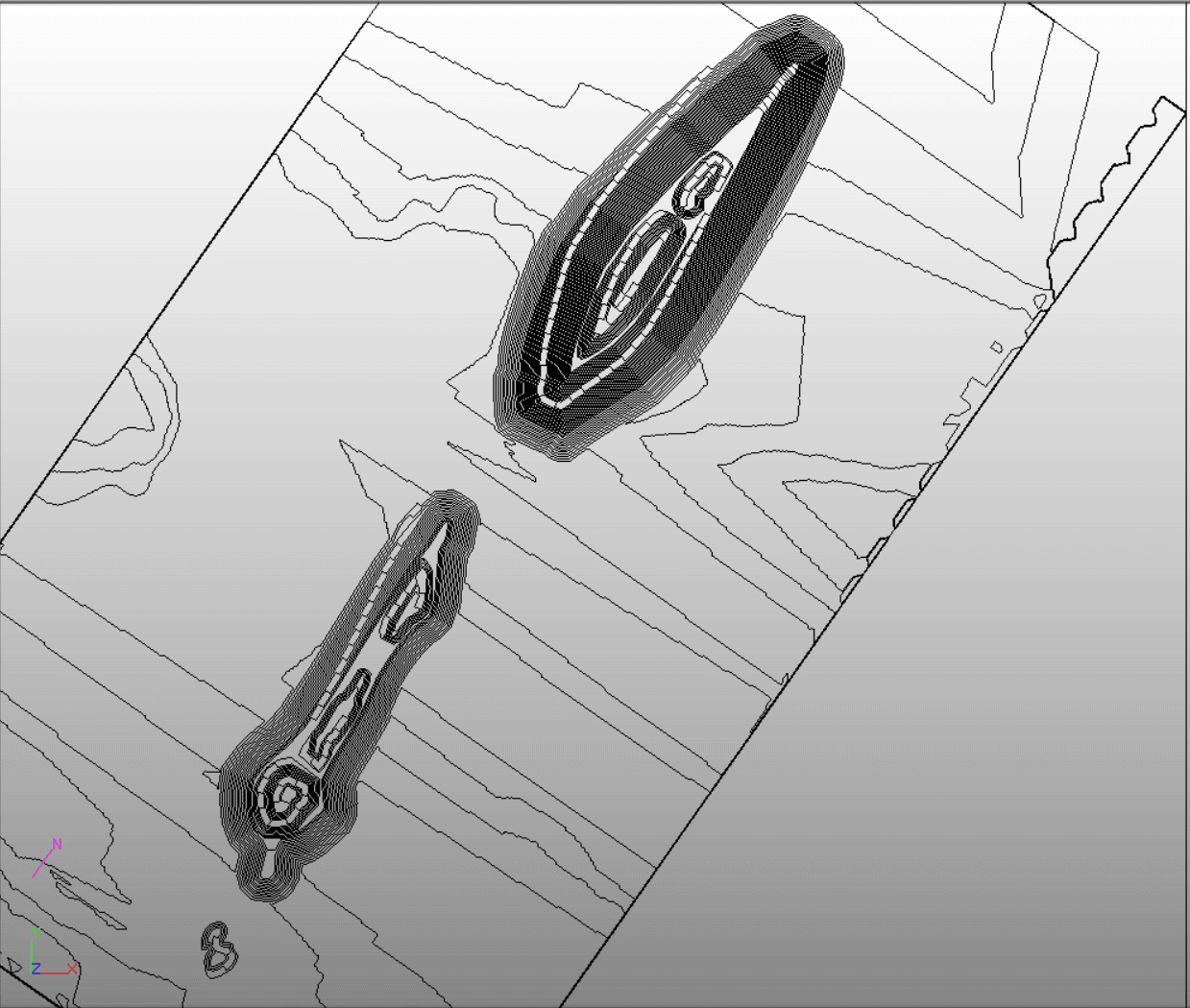
Traditional pit optimization on one estimated model produces one pit and one NPV. When the grade model is uncertain, that pit may be over-extended where the estimate is optimistic and under-extended where it is conservative. The Stochastic Open-Pit Workflow optimizes each realization independently, lets every block vote on whether it belongs in the pit, and builds the final nested pit from the blocks that a user-defined majority of realizations agree on. Because the consensus is constructed as a slope-constrained nested pit rather than derived from the block model alone, the output is a practical, buildable design that goes straight into pushback design and scheduling.
The workflow is driven from a single tabbed dialog that orchestrates the existing Pit Optimization and Stochastic Multi-Pit Scheduler dialogs, so no new parameter sets need to be learned. The whole pipeline is also exposed through the GeoMine automation interface for scripted or batch use.
The Stochastic Open-Pit Workflow depends on the following GeoMine modules: FlowPit, QuickPit and Stochastic Multi-Pit Scheduler.
Key Benefits:
- A Practical, Buildable Pit: The consensus pit is a genuine nested pit built with FlowPit's slope constraints, so it can be designed, benched and ramped like any other pit. Every other stochastic pit approach works on the block model alone and never produces a practical pit design: the output is a set of block probabilities or an averaged shell that neither has required ramps, nor respect slope geometry, and the uncertainty analysis is lost the moment a deterministic pit has to be manually amended to get something buildable.
- Risk-Qualified Pit Design: The consensus pit contains only the blocks that a user-chosen fraction of realizations agree should be mined, so the design is robust to grade uncertainty instead of tuned to one estimate.
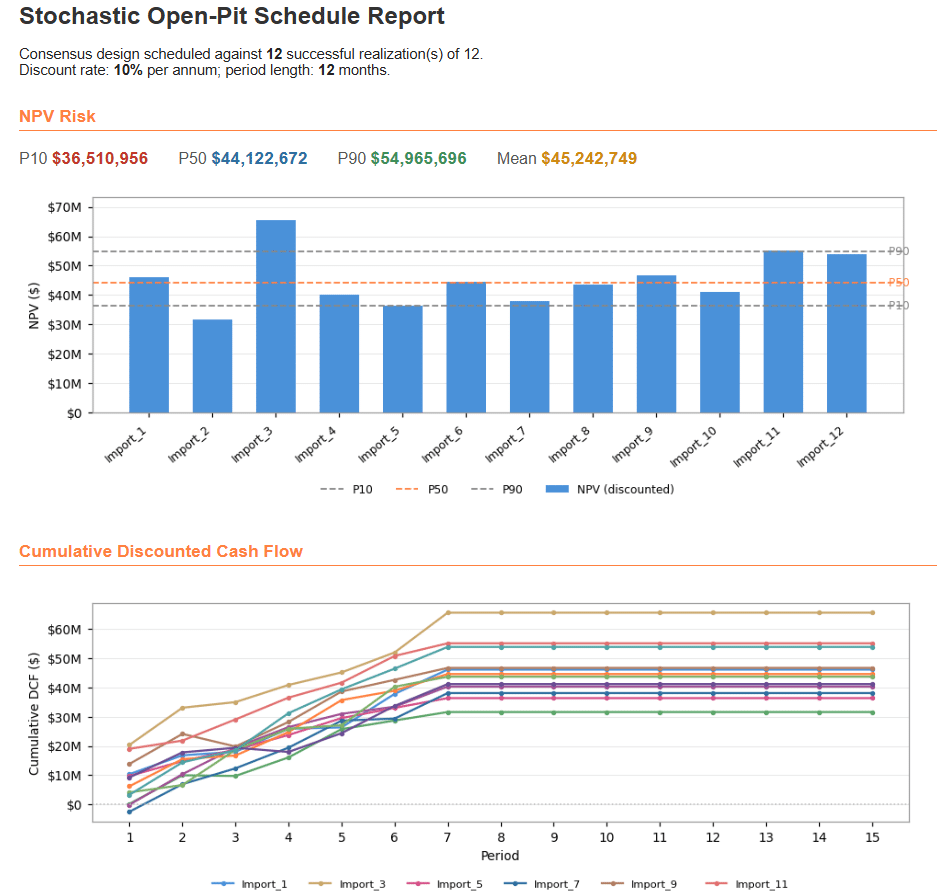
- NPV Distribution, Not a Point Estimate: Scheduling the consensus pit against every realization yields P10 / P50 / P90 / Mean NPV, giving management a defensible range for the project value.
- Visible Uncertainty: Per-block pit probability is written to the block model as an attribute, so the marginal zones of the pit can be seen and drilled, not guessed..
- Productivity: N pit optimizations and N schedules are run from one dialog in one unattended pass, replacing days of manual scenario management.
- Consistency: Uses the same FlowPit and iSchedulerOP engines, slope definitions and Formula Editor economics as your existing deterministic pit work.
Feature List:
Multi-Realization Pit Optimization
Runs FlowPit once per block model realization with a common set of optimizer parameters. Any number of realizations already loaded in the session can be processed in one pass.
Consensus and Non-Consensus Modes
In consensus mode, each realization’s pit is voxelized and every block accumulates one vote per realization that mines it. In non-consensus mode the workflow simply returns N independent pits and their statistics for percentile analysis.
Level-Vote Consensus Nested Pit
Votes are tallied per pushback level so that the consensus is built as a nested pit with a user-specified number of pushbacks, ready for scheduling. The probability threshold (for example, 0.5 for majority agreement) is user controlled.
Pit Probability Attribute
Writes the per-block mining probability to the reference block model as a continuous attribute for color-mapped visualization, filtering and reporting.
Percentile Pit Materialization
Optionally keeps the P10, P50 and/or P90 realization pits in the scene alongside the consensus pit so the spread of pit shells can be compared visually. Defaults to P50 only.
Per-Realization Reserve Statistics
Reports dollar value, ore tonnage, waste tonnage, metal quantity and stripping ratio for every realization’s pit and summarizes them as P10 / P50 / P90 percentiles.
Stochastic Multi-Pit Scheduling
Holds the consensus nested pit fixed and runs the Stochastic Multi-Pit Scheduler once per realization to produce the per-realization NPV and the resulting NPV distribution.
HTML Risk Report
Generates a self-contained HTML report with NPV risk distribution and production charts, plus a companion CSV of the chart data for audit or further analysis in Excel.
Integrated Workflow Dialog
A single tabbed dialog orchestrates pit optimization, consensus construction and scheduling, and remembers its settings between sessions.
Automation Interface
Every step (nested pit generation, voting accumulator, consensus pit builder, scheduler) is available as a COM object from the GeoMine C# scripting environment for batch, sensitivity and unattended runs.
System Requirements:
CPU: Quad Core
RAM: 16gb
HARD DRIVE: 500gb SSD
VIDEO CARD: 1gb VRAM
CPU: 3rd Gen Ryzen 5/7 or Intel i7
RAM: 32gb
HARD DRIVE: 1tb SSD
VIDEO CARD: 2gb VRAM