

SubLevel Caving Optimization, Design & Scheduling
GeoMine SLC (SLC) is a sublevel caving optimization, parametric design and scheduling tool. It includes a sublevel caving envelope optimizer, a multi-level ring designer and a ring-by-ring production scheduler. Given a grade model and a set of economic parameters, SLC finds the sublevels and ring positions worth mining, generates the matching multi-level design on the same ring grid, and schedules it top-down, level by level, with stage-based extraction, dilution from above and value-based draw control.
SLC Key Benefits
- One set of assumptions from envelope to schedule. Stage extraction and dilution, draw control, block model, formulas and blasting share are stored with the envelope. They carry through to the cave design and the scheduler, so the schedule mines what the envelope valued. Any mismatch is flagged before a run
- The envelope values what will actually be drawn. Each ring cell is valued as one blended draw at its planned extraction, not block by block in situ. Marginal rings therefore don’t turn negative once dilution is applied.
- The designer builds exactly the envelope’s rings. Both use one shared ring grid: the same ring size, front drive direction and stagger between sublevels.
- Realistic SLC economics. Drilling and blasting is charged on every tonne broken, whether drawn or not. Loading and hauling is charged only on tonnes drawn. A minimum draw keeps blasted rings flowing.
- Built for SLC, not adapted from block caving. There are no drawbells, no undercut and no cone draw. The mining unit is the ring, blasted full height from the sublevel and drawn once.
- Complements Cavemizer. Where the orebody is steep, narrow or too competent to cave on its own, sublevel caving takes the place of block caving. For block and panel caving, see our Cavemizer page.
SLC Feature List
Sublevel Caving Envelope
- Sublevel slabs are cut at a user-defined sublevel interval, either from a reference floor elevation or from the top of the range.
- Full-height valuation per ring cell, with no floor search and no horizontal pillars.
- Stage-based extraction and dilution: sponging, pre-caving and caving, following the SLD method.
- Each column takes its best contiguous run of sublevels.
- A 2D minimum-width contiguity constraint per sublevel removes scattered, unminable cells.
- Inputs for dilution cost, minimum draw and blasting share of mining cost.
Parametric Multi-Level Ring Design
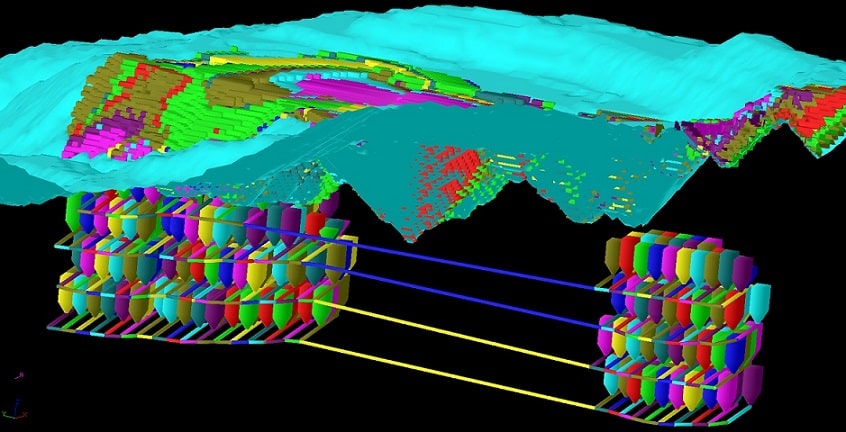
- Automatic multi-level design generated from the envelope.
- Prismatic rings sized ring length × crosscut spacing × sublevel height.
- Staggered alternate sublevels.
- Crosscuts along a selectable front drive direction.
- Rings are placed only where the envelope lies both above and below them, so none end up under overhangs.
Sublevel Caving Reserves
Static reserves calculation with staged dilution: sponging, pre-caving and caving extraction and dilution thresholds, after Kvapil.
Sublevel Caving Scheduling
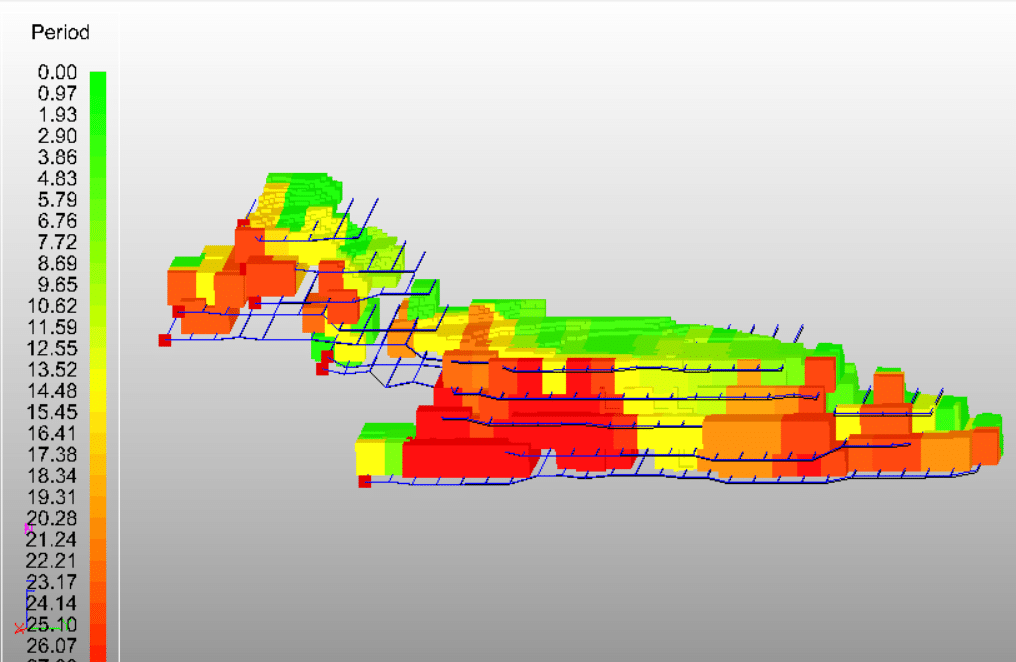
- The ring is the mining unit, drawn top-down by level.
- Retreat along each drift in either direction.
- Sequencing controls: drift rate per period, maximum active drifts per level, maximum active levels, and lag between levels.
- Stages are assigned by a ring’s depth below the cave roof.
- Dilution from above: first ore left behind on the levels above (carry-down recovery), then in-situ material above the roof, then waste.
- Value-based draw control: a shut-off value, with a minimum draw floor.
- Blasting cost is charged in the period a ring is blasted.
- Crosscut trimming of non-paying rings and drift ends.
- Hoisting or haulage cap, mill capacity and stockpiles.
- A dedicated Sublevel Caving tab groups the inputs as Sequencing, Dilution from Above and Draw Control.
Results and Reporting
- Per-period tonnage and grade streams, dilution reporting, NPV and discounted cash flow.
- Block-model period colour coding and a caved block model.
- HTML report generation.
System Requirements:
CPU: Quad Core
RAM: 8gb
HARD DRIVE: 500gb SSD
VIDEO CARD: 1gb VRAM
CPU: 3rd Gen Ryzen 5/7 or Intel i7
RAM: 16gb
HARD DRIVE: 1tb SSD
VIDEO CARD: 2gb VRAM