
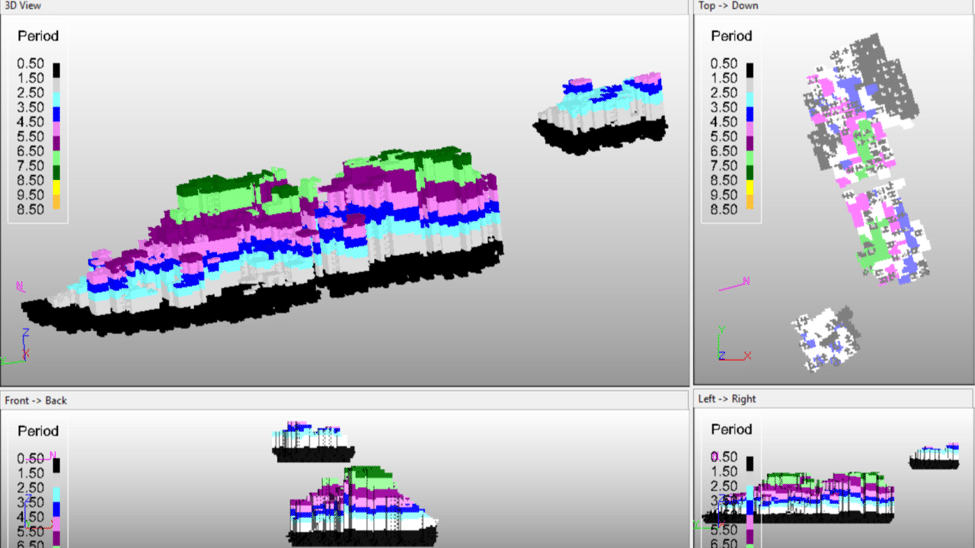
Block caving is one of the most capital-intensive and technically complex mining methods on the planet. Getting the production schedule right — sequencing draw points, managing dilution, maximizing NPV, and keeping the cave geomechanically stable — can mean the difference between a project that pays back its capital on time and one that doesn’t.
For the better part of two decades, the industry has relied on a single dominant tool for this problem: PCBC (Panel Cave Block Cave, now part of the Geovia suite). PCBC is a mature, well-validated platform, and its position at the center of most block cave feasibility studies is well-earned.
But PCBC was designed around a specific abstraction — the draw point — and that abstraction, while computationally efficient, introduces a disconnect between design and scheduling that costs time and accuracy at every stage of a project.
We built something different.
How PCBC Works — and Where the Abstraction Costs You
PCBC schedules at the draw point level. A draw point aggregates a vertical column of material — typically spanning a 15–20 meter footprint on the extraction level and 100–300 meters of column height above it. At a typical 5×5×5-meter block model resolution, that is several hundred to over a thousand individual blocks compressed into a single scheduling unit.
The practical implication: PCBC’s scheduling decisions are made on pre-aggregated draw column summaries, not on the underlying blocks. Grade, tonnage, and dilution are computed by blending the column before the schedule ever runs. The block model is an input to the pre-processing step, not a live participant in the schedule.
This works well at the production scheduling scale, where you are managing draw rates across tens or hundreds of draw points per period. But it creates friction at every stage where you need to go back to the block level:
- Reserve estimation requires a post-processing step to disaggregate draw column depletion back to individual blocks
- Cave design feedback — adjusting ring geometry, level spacing, or footprint extent based on what the schedule reveals — requires manual export, redesign, and re-import
- Multi-footprint deposits, where independent cave fronts at different elevations or locations interact, are handled as separate panels that must be scheduled independently and reconciled by hand
The draw point abstraction is not wrong. It is a deliberate and intelligent engineering trade-off. But it was made in an era when tight design-schedule integration was not technically feasible.
A Block-Level Scheduler — Built into the Design Tool
Our approach starts from a different premise: the block model should remain the live source of truth throughout design, optimization, scheduling, and reserve reporting.
Rather than aggregating to draw points before scheduling, we schedule directly at the block level. Each 5×5×5-meter block is a first-class scheduling entity, carrying its own tonnage, grade, profit-per-ton, dilution factor, stability score, and seismic sensitivity. Material flow between blocks is modelled using a physically motivated transfer fraction — essentially a calibratable parameter that controls how quickly material migrates downward to fill a void, approximating rock fragmentation, angle of repose, and inter-block friction in a single tunable value.
The scheduling loop runs period by period. Each period, drawable blocks — those no longer supported from below — are identified, ranked by a combination of the chosen heuristic and a fairness mechanism, and extracted subject to a per-period tonnage capacity constraint.
Three Heuristics, Two Fairness Algorithms
Heuristics govern what value metric drives extraction priority:
- Maximize NPV: ranks by (profit_per_tonne − mining_cost) × current_tonnage, discounted to present value
- Maximize Stability: ranks by the block’s stability factor, deferring structurally sensitive material
- Best Tonnage Efficiency: ranks by expected ore tonnes, prioritising mill feed quality over immediate dollar value
Fairness algorithms prevent draw point starvation — a geomechanically critical property, since uneven draw induces hang-ups and air blasts:
- Two-Fairness: enforces a hard primary sort on periods_waiting. Blocks that have waited longest are extracted first, with the heuristic breaking ties. Fairness is a hard constraint.
- Multiplicative Priority Boost: multiplies the heuristic score by (1 + periods_waiting × 0.2). Waiting escalates effective priority gradually — value dominates early, fairness dominates over time. A softer, more value-preserving approach.
Both mechanisms are missing from conventional draw point schedulers, which rely on the planner to manually set draw rate bounds as a proxy for fairness.
The Physics Layer
Beyond scheduling priority, the simulation maintains a genuine material flow model. As blocks are extracted, neighboring blocks — tracked spatially via Morton-coded LO codes — contribute material according to the transfer fraction. Mixed material properties (grade, dilution, stability) are updated dynamically each period. Emergency blasting can be triggered for draw points that exceed a configurable patience threshold, modelling the intervention a mine would actually make to re-mobilize a stuck column.
Stockpiling is modelled with multiple bins, per-period capacity constraints, rehandle costs, and break-even cut-off grade logic. Blending constraints enforce target grade ranges per period. Discounted cash flow and capital costs per period feed directly into the NPV calculation.
Multi-Footprint Scheduling: One Model, Multiple Cave Fronts
One area where the block-level architecture pays particular dividends is multi-footprint deposits — orebodies where independent cave fronts operate at different elevations or lateral positions within the same block model.
PCBC treats each panel as a separate scheduling entity. Interaction between panels requires manual coordination between schedule runs.
Our architecture handles multiple footprints natively. A single block model with multiple cell layouts feeds into a unified scheduling pass. The footprint optimisation step — which determines the economically optimal extraction boundary for each footprint — runs independently per layout, and the resulting designs are packaged into a single Light-Weight Stope Design object. The scheduler then operates across all footprints simultaneously, respecting shared block model constraints and the same per-period tonnage capacity.
The mesh-to-layout association is maintained explicitly through the pipeline all the way into cave design ring generation, so each footprint’s rings are correctly oriented to its own coordinate frame — not the first footprint’s frame.
Why This Matters for Credibility Against PCBC
The honest answer is that PCBC has twenty years of operational validation that we do not yet have. For a final feasibility study at a Tier 1 block cave, that track record matters and planners will continue to use it.
What we offer is different:
For early-stage and pre-feasibility work, the tight design-to-reserves loop — where footprint optimisation, cave design, scheduling, and reserve reporting all happen in one environment without file export and re-import — dramatically reduces the iteration cycle. A scenario that takes days of manual work across three or four tools can run in hours.
For multi-footprint and complex geometry deposits, the block-level approach is architecturally better suited than an aggregated draw point model. PCBC’s panel abstraction was designed for tabular, relatively uniform deposits. Non-standard geometries benefit from finer-grained control.
For geomechanical sensitivity analysis, the ability to directly vary the stability heuristic weight, the transfer fraction, the patience threshold, and the fairness algorithm — and immediately see the impact on both the schedule and the reserve — gives planners a richer set of levers than draw rate bounds alone.
For the long term, as machine learning and optimisation methods increasingly operate at voxel scale, a block-level scheduler is the right foundation. Draw-point aggregation is a one-way compression that discards the structural information those methods would need.
An Invitation
If you are working on a block cave project — at any stage from scoping through to feasibility — and you are curious whether a block-level scheduling approach adds value for your specific geometry and objectives, we would welcome the conversation.
If you are a researcher or developer working on cave scheduling, ore flow modelling, or geomechanical simulation at the block scale, we are equally interested in connecting.
And if you simply found this framing of the draw-point abstraction useful — follow along. There is more to share.
The algorithms described here are implemented within ThreeDify GeoMine, an integrated resource modeling, reserve optimization, stochastic scheduling and simulation platform. The multi-footprint design, simulation and scheduling capability is available now as part of the Cavemizer module in GeoMine.For further information, please Contact Us.