
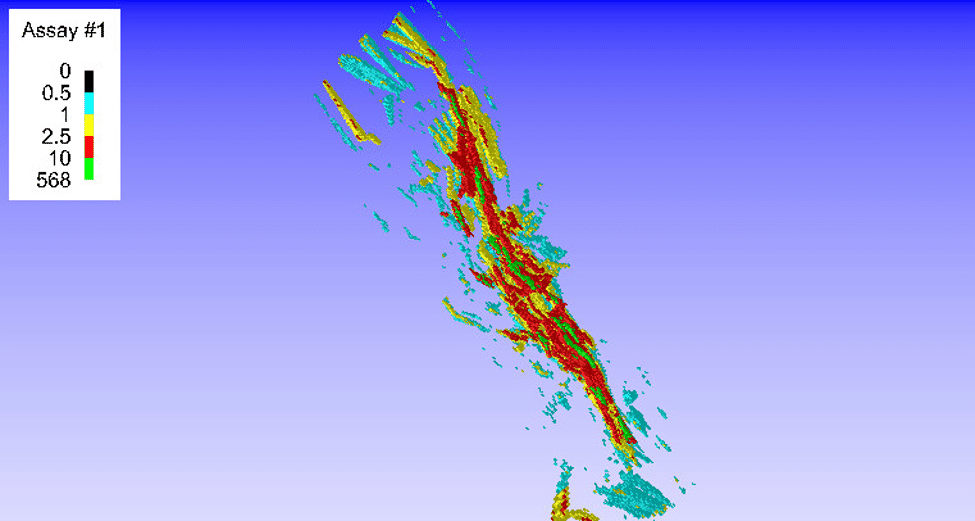
Ore grade estimation is one of the most critical and complicated aspects in mine planning and is viewed by many as an art more than science. The usual practice of resource estimation is to define a search ellipsoid whose radii correspond to the ranges of the chosen variogram. Usually, the lengths of the axes of the search ellipsoid are not the same and hence the term anisotropy. In most, except for trivial cases, more than one search ellipsoid is required to model the varied mineralization of an orebody as a small deviation in search directions from the reality can lead to misplacement or loss of ore blocks. Therefore, it is a common practice to divide a domain into several sub-domains, each of which is then assigned a unique search ellipsoid that models the mineralization of the sub-domain.Such practice is usually referred to as geological domaining or simply “domaining”. For a complex orebody, tens to hundreds of sub-domains may be needed and hence manual domaining is a tedious and error prone process.
One powerful method that has not yet received enough attention is Dynamic Anisotropic (DA) Interpolation. The technique has been known for years, but its use has been limited to a small select group of power users who know how to write custom scripts. Enter GeoMine-GeoModeler, a module in ThreeDify GeoMine mining suite, that is not only used by resource estimators worldwide, but also trusted by the ore control department of many producing mines. GeoModeler feature a powerful and easy-to-use multi-threaded DA Interpolation system. A full interpolation of millions of blocks usually takes a few minutes on a laptop with a 3rd-gen Intel Core i7 CPU. In this system, no manual domaining is needed as (hundreds or thousands of) sub-domains are auto-computed from user supplied Dynamic Anisotroy Surface(s) which can be created either automatically given a traditional wireframe or manually from cross sections.
The following two pictures contrast the difference between two interpolations, one with a single search ellipsoid (Figure 1 where the search ellipsoid is located in the lower left corner and is colored yellow) and the other with a set of dynamic anisotropy surfaces (Figure 2).
Figure 1: Block Model Interpolated with a Single Search Ellipsoid
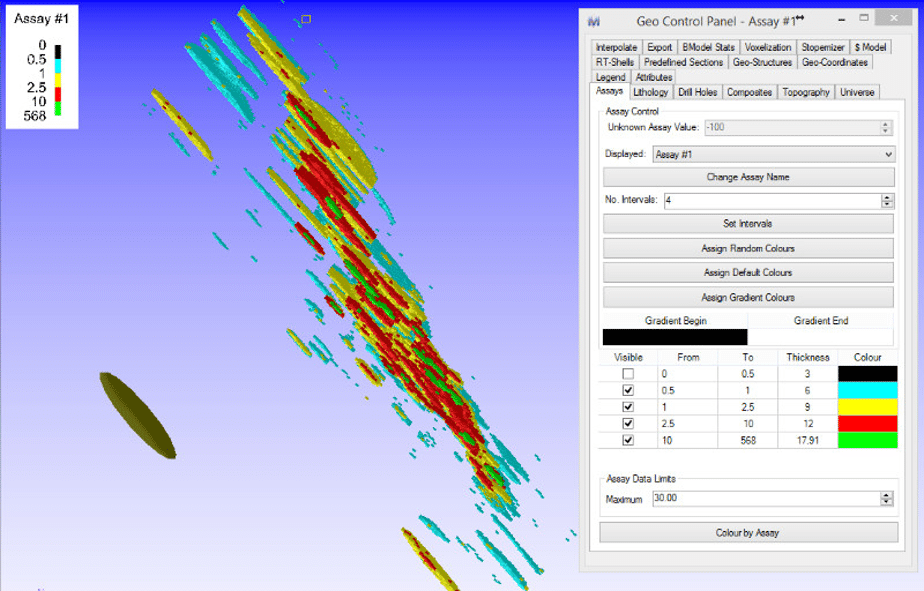
Figure 2: Block Model Interpolated with a Set of DA Surfaces
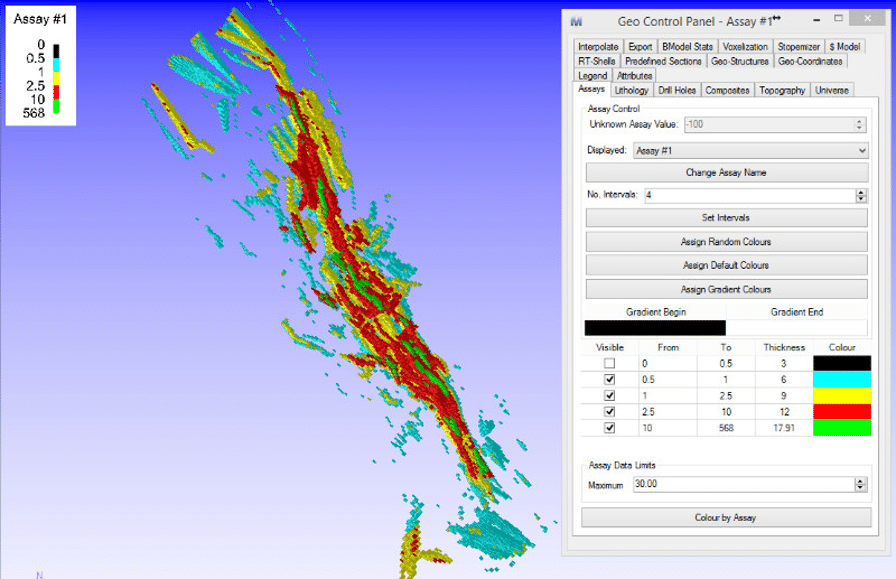
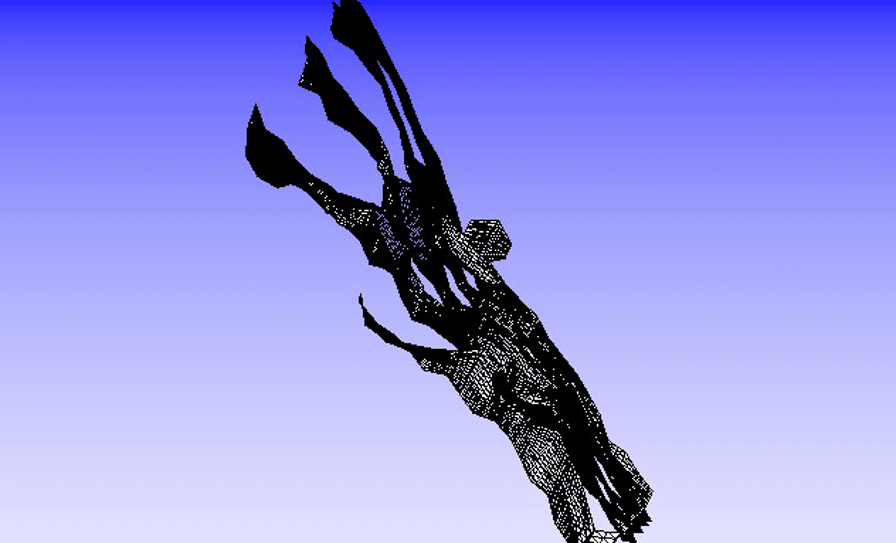
Figure 3: Below Shows the DA Surfaces Used for the Above DA Interpolation
As it can be seen, the block model interpolated using a single-search ellipsoid closely follows a single direction that is dictated by the search ellipsoid’s major axis whereas the block model interpolated using DA follows many such directions as dictated by the DA surfaces.
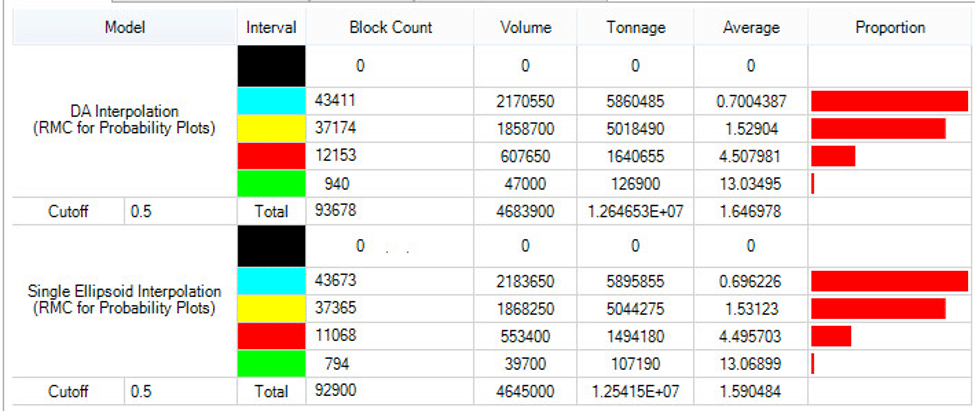
Figure 4 below shows that DA interpolation resulted in a higher average grade above the cut-off (0.5g/t) than the single search ellipsoid interpolation: 1.64g/t vs 1.59g/t. The latter produced quite fewer blocks in the medium to high grade intervals (red and green), i.e., 11068 vs 12153 blocks in the red interval and 794 vs 940 in the green interval. This means that the single search ellipsoid interpolation underestimated high grade and overestimated low grade. In other words, it exhibits more severe smoothing effect which tend to cause loss of mineral due to wrong classification of ore blocks into waste blocks when in-situ cut-off grade is high due to a low market metal price.
Figure 4: Block Model Statistics
There is no longer a need for the tedious and error-prone manual domaining. Powerful and easy-to-use DA interpolation software (such as GeoMine-GeoModeler among others) already exists and can easily save you weeks of work with more accurate results. For further information, please Contact Us.