
Reblocking, aka super-blocking, is a block aggregation or model size reduction technique. Super-blocking has become a common practice when it comes to pit optimization. More often than not, grade models created by geologists far exceed the ability of most pit optimizers on the market today. A grade model with 100 million non-air blocks is not uncommon whereas most pit optimizers can only handle block models with fewer than 10 million blocks. As a result, mine planning engineers often need to super-block their grade models to a much smaller dimension before a pit optimization run is attempted.
This begs a question: what is the impact of super-blocking on NPV (Net Present Value)?
In general, there are two types of reblocking: 1) Reblocking by grade which aggregates several blocks (up to hundreds) into a super-block and assigns the average grade to the super block. It introduces dilution due to averaging (aka the smoothing effect); 2) Reblocking by dollar value which aggregates blocks into a super block and assigns the sum of the dollar values of the individual blocks to the super block. This type of reblocking does not introduce dilution.
Type 1) is usually done by the end user prior to a pit optimization run while Type 2) is normally carried out by a pit optimizer internally at the scheduling stage. Type 1) is required when the individual block size is much smaller than the SMU (smallest mining unit) of the project and hence not reblocking would artificially inflate the value of the project. Type 2) is recommended only if the block size is the same as or close to the SMU of the project.
This article is about the impact of Type 1) on pit optimization.
Usually, comparisons shall be made based on the NPV (Net Present Value). However, there is currently no consensus on the standard for the scheduling algorithm. So as a valid fallback, we can look at the effect of super-blocking on the profit of the optimal ultimate pit as determined by the industry’s standard Lerchs & Grossman algorithm.
Even with the slightly changed criterion, i.e., profit (instead of NPV) vs relocking factor, it is still not an easy task to quantify the effect as most commercial pit optimizers are not designed to handle big block models, a capability that is a must for this exercise.
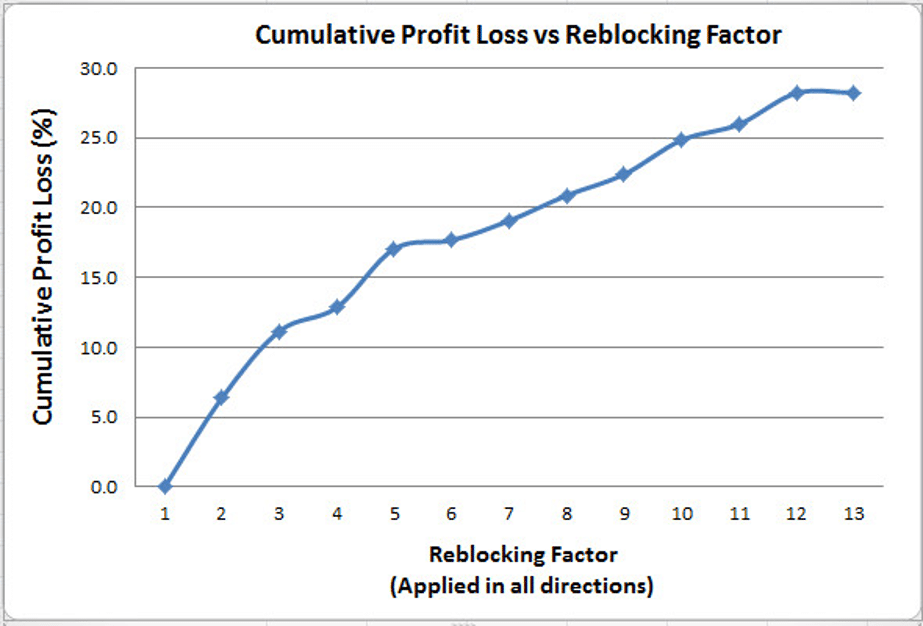
Using FlowPit, ThreeDify’s ultra-fast and scalable pit optimizer, we conducted a series of ultimate pit optimization runs on a real-life block model with about 94 mil (2m x 2m x 2m) blocks using a 45 degree slope angle. The result is shown below:
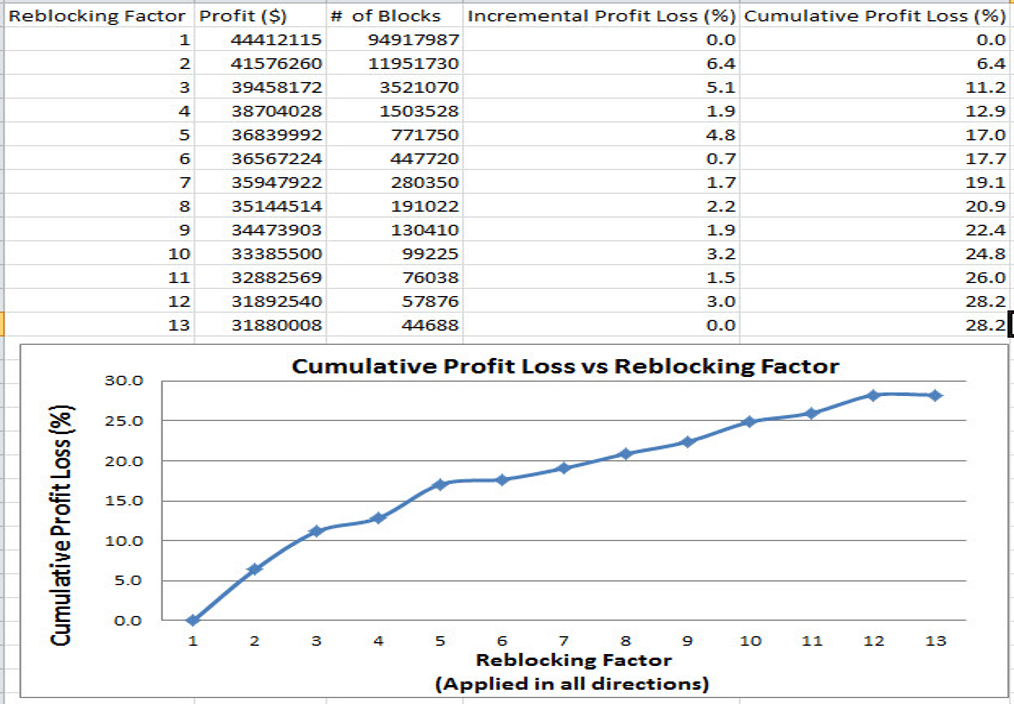
With the reblocking factor of 1, ie., no reblocking at all, the profit in the ultimate pit is around $44mil. With the reblocking factor of 2 being applied in each of the 3 directions, the total # of blocks is reduced to around 12 million blocks and the profit is reduced by 6.4%, a sizable reduction. Then at the reblocking factor of 3, the total # of blocks is reduced to around 3.5 mil and an accumulative profit loss of 11.2% is incurred. Further reblocking incurs less severe profit loss afterwards, but is still sizable.
What is the effect of reblocking on ore/waste/metal tonnage then? Take a look at the figure below:
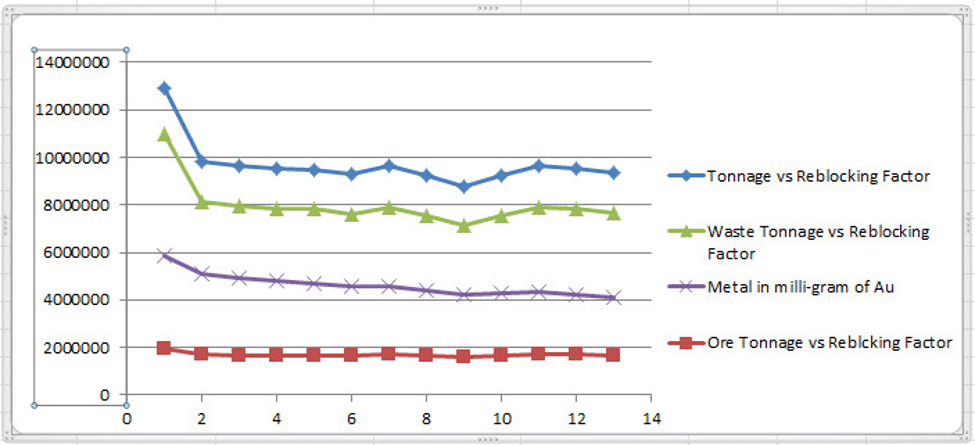
There is just a slight change in ore tonnage (the red curve) between different reblocking factors, due to the effect of dilution. The changes in metal quantity (the purple curve) and waste tonnage (the greenish yellow curve) are more obvious between different reblocking factors. There is an obvious drop of both metal quantity and waste tonnage on 1st reblocking. Except at reblocking factors of 7, 10 and 11 (which are not of practical usage), waste tonnage decreases as the reblocking factor increases. This implies that in general (although not always), less waste is mined as the reblocking factor increases, and hence resulting in a steeper pit slope angle (since ore tonnage remains more or less constant over a range of reblocking factors). The steeper slope angle is generally expected as the block size increases due to the discrete nature of block models and the fact that slope angles are calculated using block centers.
What to take from this exercise: reblocking can materially affect the profit of your project and hence should be carried out only if you know its impact to your project.
This exercise uses a uniform reblocking factor in all three directions. No attempt is made to analyse the impact of non-uniform reblocking factors on the profit and pit slope angles. Also as each project is unique, it is best to conduct a series of reblocking runs to find the best reblocking factor for your project. Tools for such reblocking analysis are already available. Just be sure to choose a pit optimizer that can handle tens of millions of blocks in a timely manner.
Happy informed reblocking…