
For the past few years, infill drilling optimization has been a workhorse of resource development. It tightens the spacing, knocks down the kriging variance, pushed Inferred resources into Indicated. Commercial infill optimizer such as GeoMine OreChaser have been available and well understood.
But what about the resource we haven’t found yet?
Every deposit eventually presents the same question: should we keep drilling beyond the modelled extents, and if so, in which direction? That step-out decision has traditionally been made on a whiteboard with a long-section and a fair amount of intuition. It works — and it also leaves money on the table, because the algorithmic rigor we apply inside the block model has rarely been extended to the territory just outside it.
Why We Need It
Mine economics today are unforgiving in two directions. Drilling budgets are scrutinized line by line, and yet the cost of not extending a known orebody is often an order of magnitude larger than the drilling spend itself. A poorly chosen step-out program burns a few hundred thousand dollars; a missed extension can cost tens of millions in NPV.
What has changed recently is that structural data — logged dip, azimuth, and reliability ratings from oriented core and televiewer surveys — now flows into modern drill hole records as first-class attributes. The information needed to project an orebody’s continuation in a geologically defensible way is already in the database. It just hasn’t been wired into the drilling optimizer.
How It Works
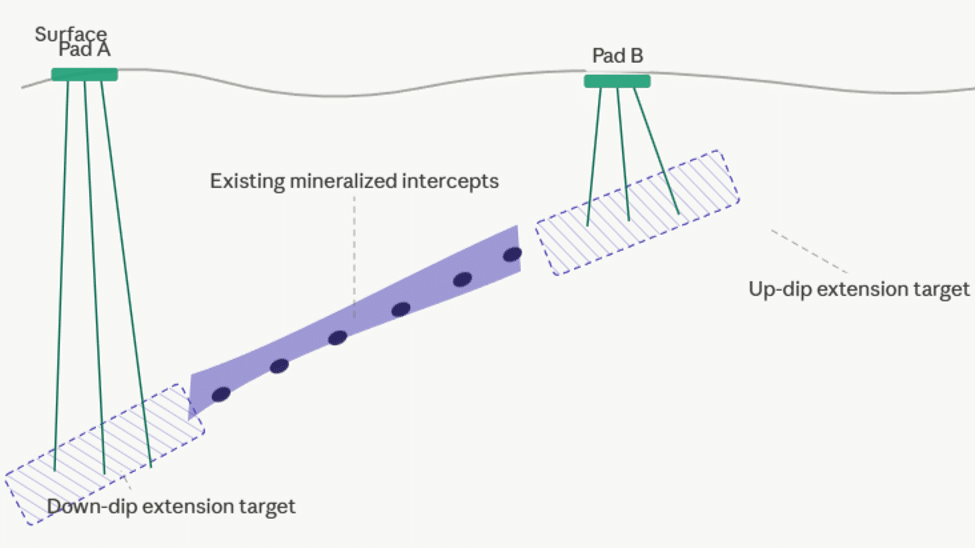
The Step-Out optimizer in the newly released GeoMine OreChaser v6.5.5 treats step-out as a natural extension of infill. It examines the orebody’s three-dimensional geometry to identify its strike and dip endpoints, then queries the surrounding structural measurements to determine which way the body is most likely to continue. The output is a small set of oriented target volumes projected outward from the body’s tips, each carrying a structural-confidence score derived from the density and agreement of nearby measurements.
A simulated-annealing engine — the same one used for infill in GeoMine’s OreChaser Infill Optimizer — then generates competing drilling plans against those targets, applying the existing infill plan’s footprint as an automatic exclusion so step-out fans never re-drill covered ground. Because the targets sit outside the block model, the optimizer also computes a discovery score weighted by structural confidence, giving the objective function a meaningful signal in territory the block model doesn’t cover.
The result is the same multi-plan ranking dialogue teams already use for infill, with two new columns: Discovery Tonnage and Average Structural Confidence.
Where the Value Is Largest
Step-out optimization is strongest on tabular and structurally controlled deposits — coal seams, IOCG sheets, sediment-hosted base metals, shear-zone gold — and on advanced exploration to early-mine-life projects that already have a credible block model and disciplined structural logging. Brownfields exploration around producing mines is a particularly good fit, where pad locations and drilling costs are well constrained, and the real question is where to extend.
Deposits with weak structural control (large isotropic porphyry systems) gain less, and green fields without a block model gain nothing — the optimizer extends what you have; it doesn’t hypothesize from scratch.
The Bigger Picture
The most interesting thing about this capability isn’t the new code — it’s how much of the existing infill engine it reuses. Resource teams that have already invested in infill optimization software like OreChaser Infill Optimizer are one extra step away from creating a defensible step-out plan. Small marginal cost, large marginal value on the right project.
We’ve spent a long time getting better at proving up the ore we already know about. Time to bring the same discipline to the ore we don’t.
For further information on Step-Out Optimization, please Contact Us.